Only switch your HVAC to emergency heat if your heat pump completely fails or is damaged and inoperable, as it’s a temporary, costly last resort. Don’t use it for normal cold weather or to heat your home faster.
What Exactly is Emergency Heat?
Emergency heat is an electric resistance heating system designed as a backup. Unlike your regular heat pump, it doesn’t transfer heat from outside air.
Instead, it relies solely on electric heating coils inside your indoor unit to generate warmth. It’s meant for specific, urgent situations, not for everyday heating.
Emergency Heat vs. Auxiliary Heat: Understanding the Key Difference
It’s easy to get confused between Emergency Heat or Auxiliary Heat, but they work very differently.
Auxiliary Heat (Supplemental Heat)
-
- Your thermostat triggers this automatically.
- It kicks in when outdoor temperatures are too low for your heat pump to warm your home efficiently.
- Also engages during the heat pump’s defrost cycles.
- Works with your heat pump, adding warmth when needed.
Emergency Heat:
-
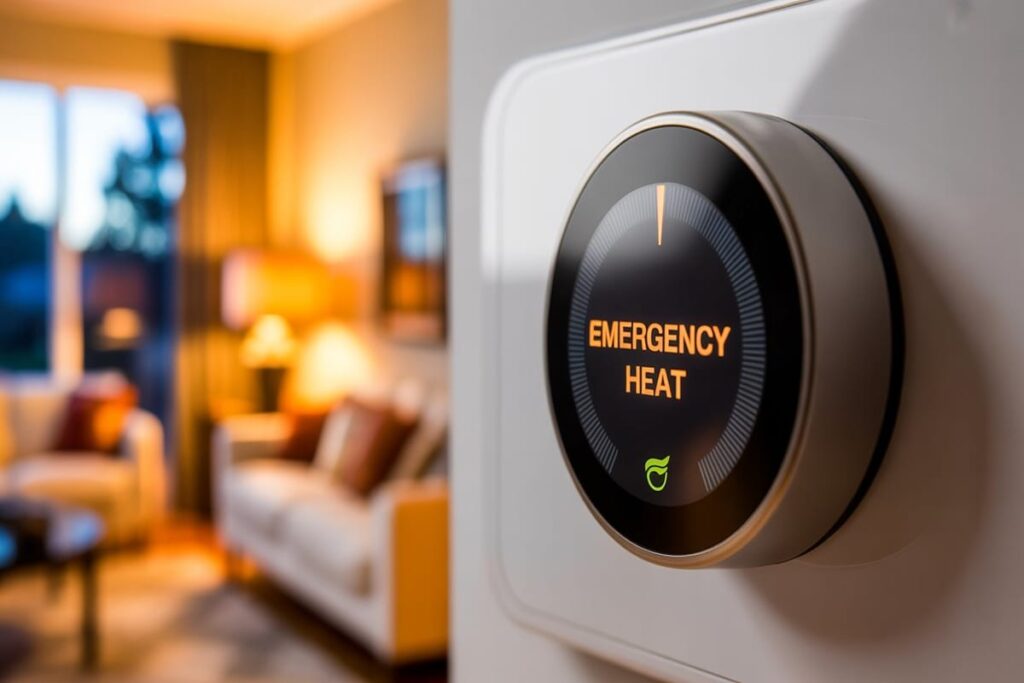
- You must switch this on manually, usually with a dedicated button on your thermostat.
- It completely disables your heat pump, overriding its normal operation.
- Only uses those expensive electric resistance coils, serving as a “last resort” heating method.
When You Should Switch Your HVAC to Emergency Heat
Knowing when to switch HVAC to emergency heat is crucial, as it should be a rare event.
- Complete Heat Pump Failure:
- Your system is blowing cold air, or no air at all.
- The outdoor unit is completely frozen over and won’t defrost, or it shows obvious damage.
- You hear alarming noises like grinding, clunking, or screaming from the outdoor unit.
- Heat Pump is Damaged and Inoperable: If a technician confirms a critical component failure, like a compressor breakdown or a serious refrigerant leak, making the heat pump non-functional.
- Temporary Measure During Repairs: To keep some heat in your home while you wait for a professional HVAC technician to diagnose and fix your broken heat pump.
When You Should NOT Switch to Emergency Heat
Avoid using emergency heat in these common scenarios:
- Normal Cold Weather: If your heat pump is just working harder in low temperatures, auxiliary heat should come on automatically to help out.
- To Heat Up Faster: Emergency heat isn’t for quicker heating; it’s a very expensive backup.
- If Your Heat Pump is Merely Struggling: A struggling heat pump signals a problem that needs attention, but it doesn’t automatically mean you need emergency heat. Let auxiliary heat assist, then schedule a service appointment.
- Ignoring an Underlying Problem: Relying on emergency heat indefinitely can hide a critical issue with your heat pump, leading to much bigger, more costly repairs down the road.
The High Cost of Running Emergency Heat
Let’s be clear: electric resistance heating is one of the least efficient and most expensive ways to warm your home. It’s truly a last resort.
It burns through significantly more electricity than a functioning heat pump. This translates directly to much higher utility bills.
Unlike a heat pump that efficiently moves heat, emergency heat has to generate all that heat directly from electricity, which takes a lot of power.
What to Do If You Suspect Your Heat Pump Isn’t Working
Before hitting that emergency heat switch, try these steps:
- Check Your Thermostat Settings: Make sure it’s set to “Heat” and the desired temperature is above your current room temperature.
- Inspect the Outdoor Unit: Look for excessive ice, debris blocking airflow, or any visible damage to the unit.
- Perform a Soft Reset: Turn off the power to your HVAC system at the circuit breaker for 5-10 minutes, then switch it back on.
- Observe Auxiliary Heat: In very cold conditions, check if the auxiliary heat indicator on your thermostat lights up automatically.
- When to Call a Professional: If your heat pump still fails, blows cold air, or if you often find yourself thinking about emergency heat, it’s time for expert help.
- Addressing minor issues early can prevent major breakdowns. For reliable diagnostics and fixes, consider professional heat pump repair services.
- If your system is old or constantly breaking down, it might be more cost-effective long-term to look into a new heating system for improved efficiency and reliability.
Trust The Weatherman AC for Your Heating Needs in Lake Havasu City
Your home’s comfort and safety are our top priorities, especially when outdoor temperatures drop in Lake Havasu City. If you’re unsure about using emergency heat, or if your heat pump isn’t functioning as it should, don’t hesitate to reach out to our team of experts.
Contact The Weatherman AC today for expert heating, ventilation, and air conditioning solutions.
We’re here to ensure your home or business in Lake Havasu City stays warm, efficient, and comfortable all season long.